Download the Conference Proceedings
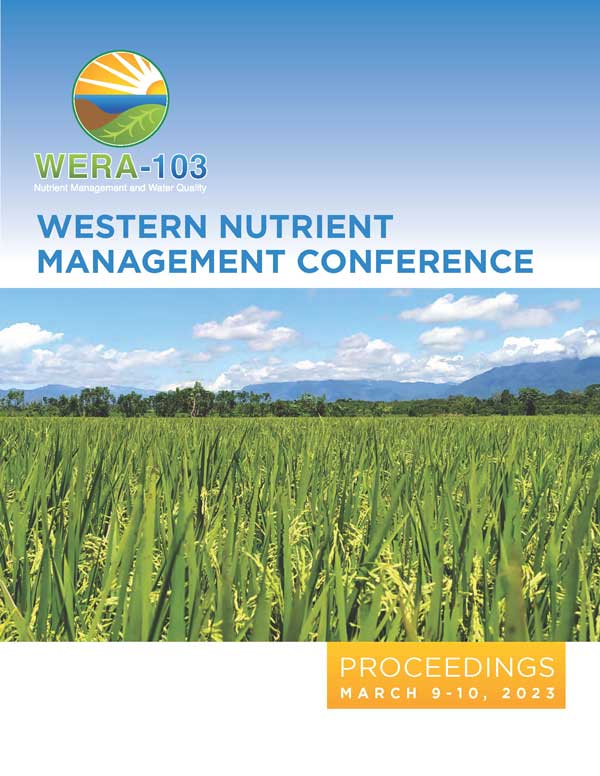
Proceedings
Authors
| Filter results4 paper(s) found. |
|---|
1. Reducing Dairy Effluent Phosphorus Content Through Struvite ProductionForced precipitation of struvite (magnesium ammonium phosphate hexahydrate, MgNH4PO46H2O) in wastewater treatment has recently received increased attention as a method of phosphorus (P) recycling. Dairy lagoon P concentrations can be lowered, and the recovered struvite has the potential to be marketed and used as a fertilizer. Struvite may even be useful in organic production on calcareous soils, where rock P (PR) is not an option. A new organic treatment method, based on an existing... J. G. davis, J. Ippolito, M. Massey, R. Sheffield |
2. Manure Treatments Change Nitrogen Cycling in Soils Receiving Repeated Applications of Dairy-wastesOur objective was to assess effects of treated dairy-waste on soil N pools, nitrification, plant N availability, and yield in a silage cornfield treated with ammonium sulfate (AS), dairy-waste compost (DC) or liquid dairy-waste (LW) as N sources at two levels of application over 5 years. Increases in soil C and N, nitrate and available P and K were observed for the DC treated soils throughout the 5-year period. Soil organic C increases for the high-level DC treated soil doubled the C pool resulting... J. Norton, M. Habteselassie, J. Stark, B. Miller |
3. Grain Protein Content and Composition of Winter Wheat Cultivars Under Different Levels of N and Water StressThis study investigated the combined influences and interactions of N fertilization and moisture deficit during grain-fill on wheat grain protein content and grain protein composition of nine white winter wheat cultivars. Grain was obtained from seven HWW wheat cultivars and two soft white winter (SWW) wheat cultivars grown under line-source irrigation systems at two Oregon locations during two years. The low N level treatment consisted in a single fertilization of 150 lb N/a in March,... A. Ross, C. Saint pierre, C. Peterson, J. Ohm, M. Verhoeven, M. Larson, B. Hoefer |
4. Remote Sensing of Corn N Status with Active SensorsDetermining in-season corn (Zea mays L.) nitrogen (N) variability has been a research focus of agronomists for quite some time. One of the methods currently available to determine N variability in corn is remote sensing. Studies have shown that remotely sensed imagery can detect N variability in corn. However, this method can have some limitations, such as the timeliness in which this imagery can be acquired. Hand-held active remote sensing devices may overcome these limitations.... D. Westfall, R. Khosla, T. Shaver |